Depth changes what a fish structure needs to do. Cold water, dropping light, and thinning oxygen below the thermocline mean a structure that holds bluegill in 6 feet of water can sit empty at 20 feet. This guide ranks the six fish structure types anglers, pond owners, and fisheries managers actually use in deep water lakes and reservoirs in 2026, matched to depth zone and target species.
Best overall for deep water lakes: Fishiding PVC habitat attractors and cribs, built from reclaimed PVC and dense enough to hold fish through a full water column drop. Best for DIY builders: Fishiding DIY fish habitat kits, assembled and weighted on your own schedule. Best for suspended crappie: crappie stake beds set at 15 to 25 feet. Best low-cost test structure: brush piles, though they break down fast once submerged past the thermocline.
- Fishiding PVC habitat attractors win for deep water lakes in 2026; dense reclaimed PVC holds fish year-round.
- Crappie stake beds work best for suspended schools at 15 to 25 feet; wood decays faster than PVC at depth.
- Brush piles are the cheapest deep-water fish structure but break down within a few seasons below the thermocline.
- DIY fish habitat kits let pond and lake owners build deep-water structure at their own pace and depth spec.
- Fish cribs hold up in deep reservoirs only when packed dense; loosely built cribs empty out over time.
Why deep water structure decisions matter more below the thermocline
Most fish structure advice assumes shallow water: 4 to 10 feet, warm, well-lit, oxygen-rich. Deep water lakes and reservoirs don't work that way once summer stratification sets in.
A thermocline often forms at 15-30 feet in many stratified lakes, and water below it can run low on dissolved oxygen for months. Structure placed below that line only holds fish part of the year, and material that decays fast wastes the effort of running a boat and a GPS unit out to drop it.
Fishiding has spent 15+ years and thousands of hours filming freshwater fish underwater, documenting which structure types hold fish through a full season at depth and which ones sit empty by August. That footage is the basis for the rankings below.
What makes the best fish structure for deep water lakes
- Density and intricacy — sparse structure looks like cover but doesn't hold bait or predators once light drops.
- Material that survives low oxygen — wood and brush decompose faster below the thermocline than reclaimed PVC.
- Height into the water column — structure that only sits flat on bottom misses fish suspending 5 to 10 feet up.
- Weighted stability — current, ice movement, and wave action shift lightweight structure off the drop point.
- Coverage matched to contour — a single unit on a 40-acre flat doesn't do what a cluster along a creek channel does.
- Documented fish use — footage or firsthand observation beats a spec sheet; deep water structure either shows fish using it or it doesn't.
Fish structure for deep water lakes in 2026: at a glance
| Structure | Best for | Standout feature | Key limitation |
|---|---|---|---|
| Fishiding PVC attractors and cribs | Quick, mapped deep drops | Dense reclaimed PVC strands fish use season to season | Footprint per unit is limited; reservoirs need multiple drops |
| Fishiding DIY fish habitat kits | Hands-on lake owners | Custom-built to your depth and budget | Assembly and sinking take time and know-how |
| Preassembled fish cribs | Fast bottom cover in stocked reservoirs | Rigid frame holds shape against current | Loosely packed cribs empty out within a few seasons |
| Crappie stake beds | Suspended crappie at 15-25 feet | Vertical stake pattern crappie key on | Wood decays faster than PVC in low-oxygen deep water |
| Habitat mats for lake restoration | Large-scale reservoir coverage | Modular sections scale across flat bottom acreage | Sits low in the column; less useful for suspended fish |
| Brush piles | Low-cost test structure before investing | Familiar, cheap, quick to build | Decomposes within a few seasons below the thermocline |
1. Fishiding PVC habitat attractors and cribs: best for quick, mapped deep drops
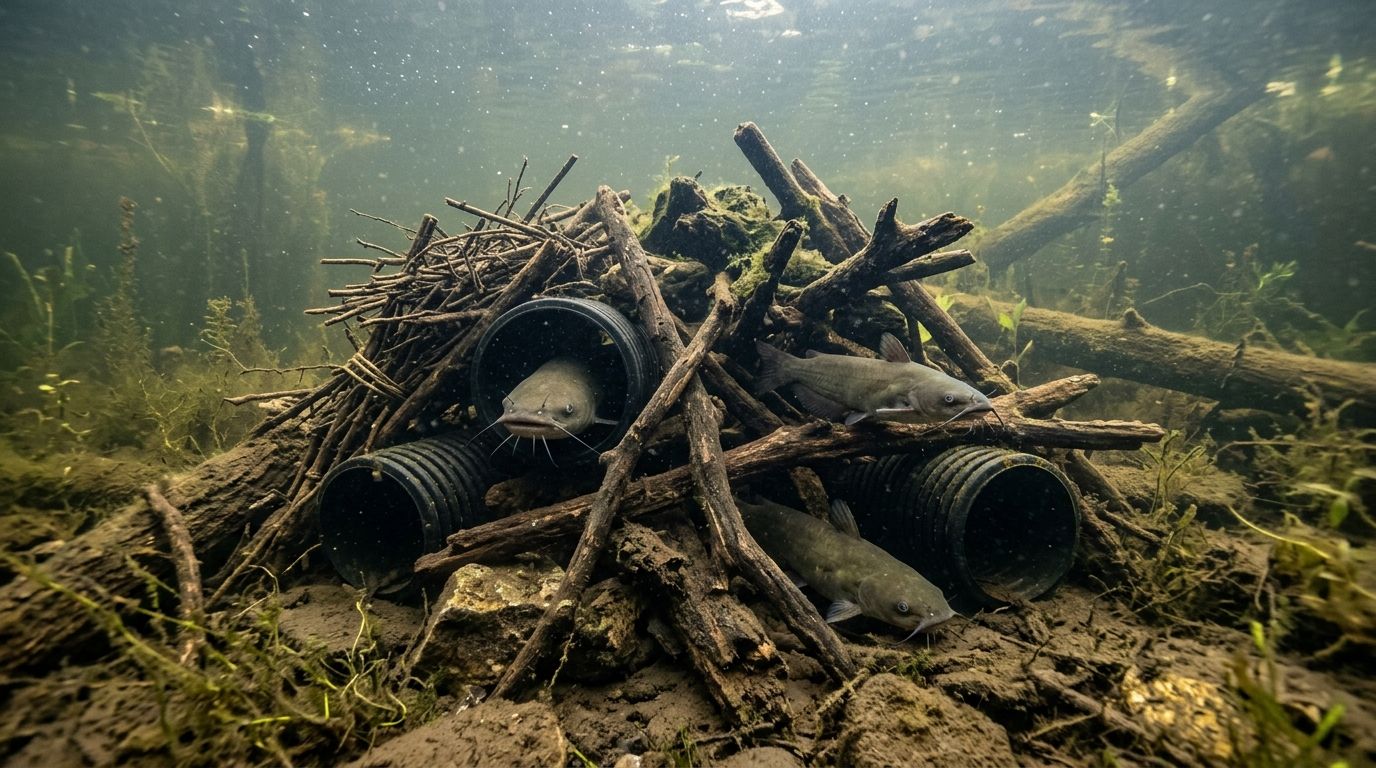
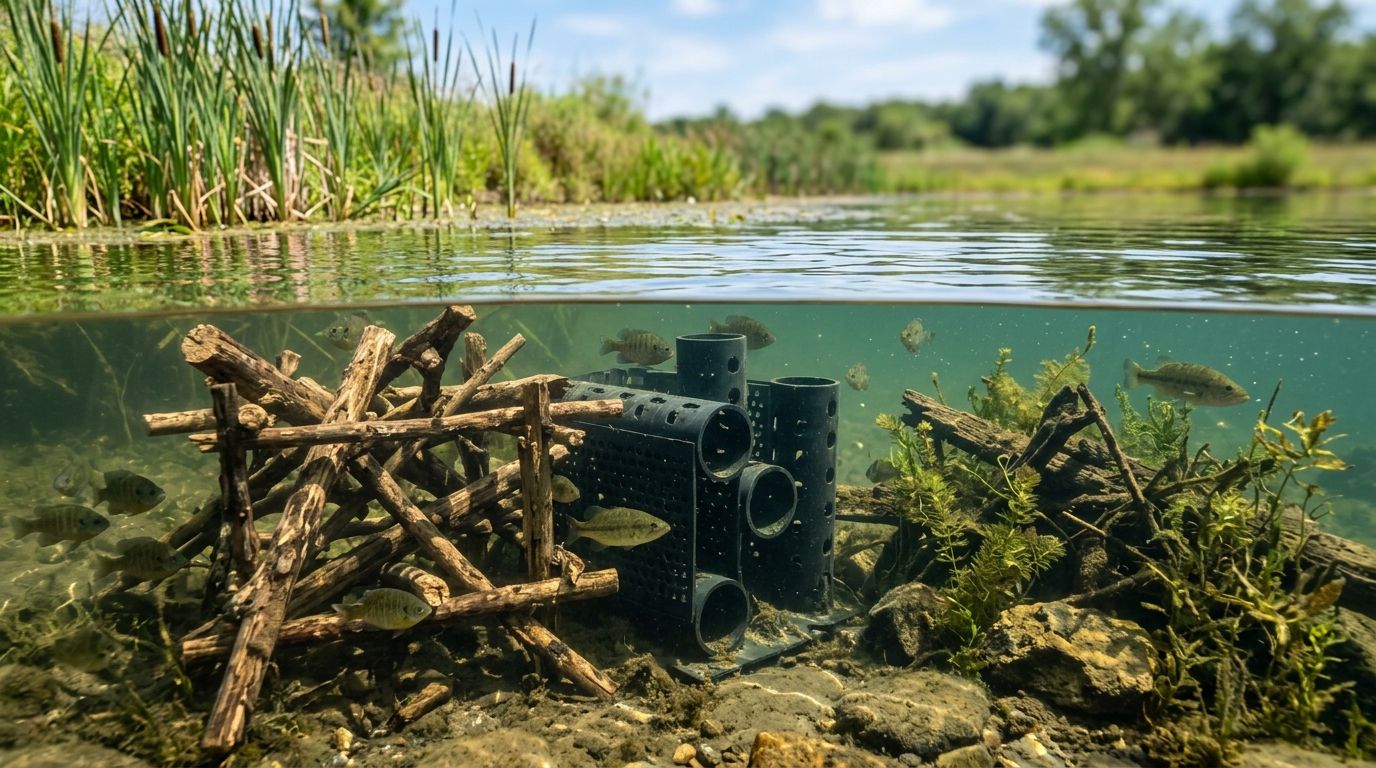
Fishiding builds these structures from reclaimed PVC that was headed for a landfill, cut and layered into dense, intricate shapes that mimic natural brush without the decay. Units drop straight to bottom and hold their shape at depth, unlike wood or loose brush.
Underwater footage collected over 15+ years shows all freshwater species using this dense structure at some point, from fry hiding in the strands to bass and crappie staging nearby. That documented use, not a spec sheet, is why this sits at the top of the list for deep water lakes in 2026.
Fishiding attractor pros:
- Reclaimed PVC holds shape and doesn't decompose the way wood or brush does below the thermocline
- Preassembled, so no on-site build time before the drop
- Dense, intricate design gives cover and forage space through the water column, not just at the bottom
- Documented across freshwater species in underwater footage
Fishiding attractor cons:
- Each unit covers a limited footprint, so a reservoir-scale project needs multiple drops
- Costs more per unit than raw DIY materials
- Best results come from clustering units, which means planning a placement map before you buy
Best for: private lake owners and reservoir managers who want structure in the water this season, not next.
Verdict: Buy.
2. Fishiding DIY fish habitat kits: best for hands-on builders
Fishiding DIY fish habitat kits ship the reclaimed PVC components raw, so you cut, layer, and weight structure to your own depth spec instead of buying a fixed size.
DIY kit pros:
- Lower material cost per structure than preassembled units
- Build density and height to match your exact drop-off contour
- Same reclaimed PVC material as preassembled Fishiding structure, so it holds up the same way at depth
DIY kit cons:
- Assembly and weighting take time before the first drop
- Results depend on how dense you build it; sparse DIY structure underperforms preassembled units
- Not ideal if you need cover in the water before a specific stocking date or tournament
Best for: owners building a large number of structures in-house on their own timeline.
Verdict: Buy, if you have the time to build it right.
3. Preassembled fish cribs: best for fast bottom cover in stocked reservoirs
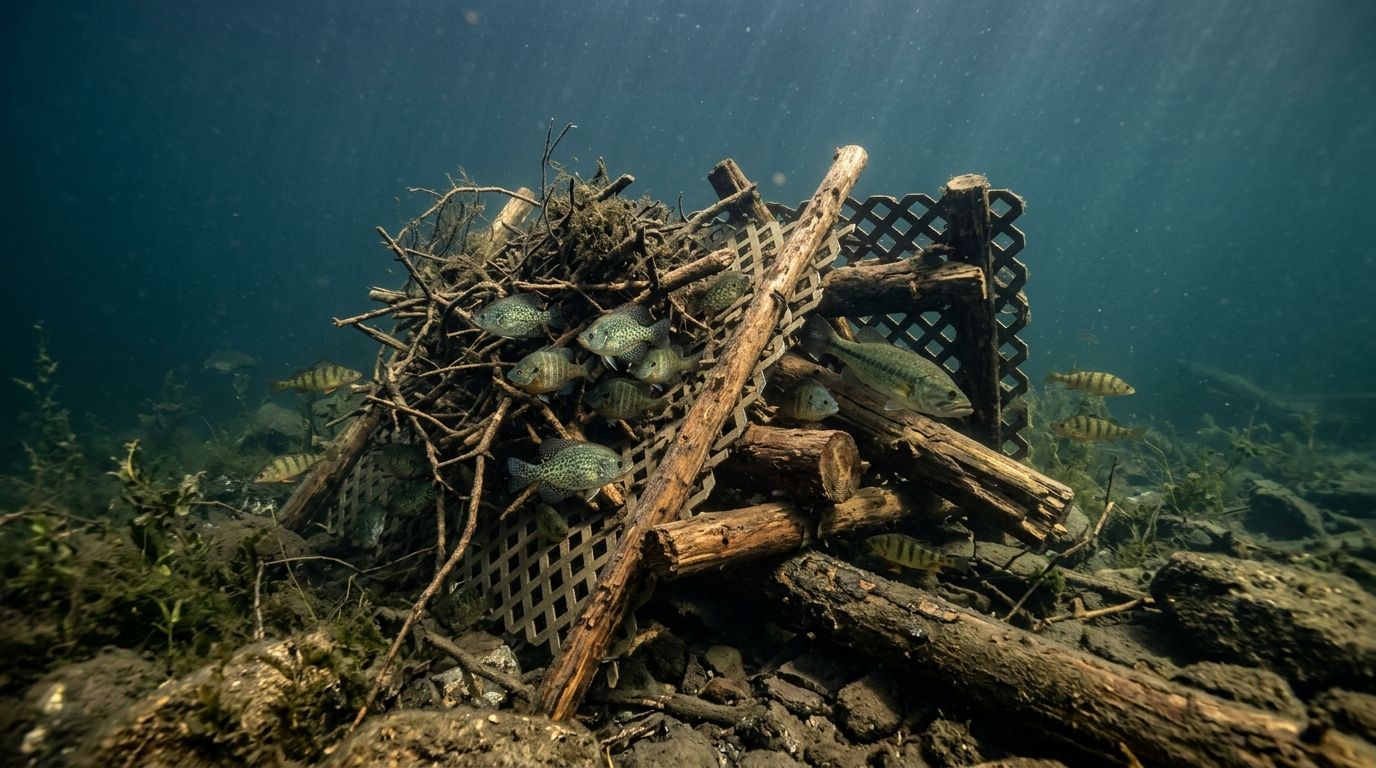
Fish cribs are rigid frames, often crib-style cages, loaded with cover material and sunk to hold a fixed footprint against current. They've been a fisheries-management standard for decades in stocked reservoirs.
Fish crib pros:
- Rigid frame resists current and doesn't drift off the drop point
- Familiar to most fisheries managers and easy to justify in a stocking plan
- Works at depth without the buoyancy problems loose brush has
Fish crib cons:
- Cribs only work when packed dense; loosely built cribs collapse or empty out within a few seasons
- Cover material inside the frame, often wood, still decays faster than reclaimed PVC
- Rigid shape gives less of the intricate branching that draws smaller forage fish
Best for: fisheries managers who need a fixed, current-resistant footprint in a stocked deep reservoir.
Verdict: Hold — check crib density before committing a stocking budget to more units.
4. Crappie stake beds: best for suspended schools at 15 to 25 feet
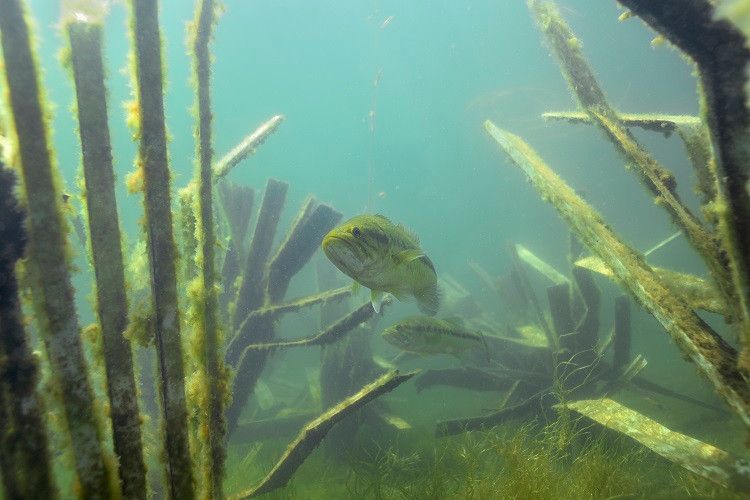
Stake beds cluster vertical poles, often cane or PVC stakes, at a set depth to mimic standing timber. Crappie key on the vertical pattern more than almost any other structure type.
Crappie stake bed pros:
- Vertical pattern matches how crappie suspend around standing timber and creek channels
- Cheap to build per stake and easy to cluster in groups
- Simple to mark and revisit with a graph
Crappie stake bed cons:
- Wood stakes decay faster than reclaimed PVC once submerged below the thermocline for multiple seasons
- Draws crappie and panfish more than bass or catfish
- Needs periodic rebuilding as stakes break down
Best for: crappie anglers targeting creek channel drops and standing timber replacement in reservoirs.
Verdict: Buy, and plan to replace stakes every few seasons.
5. Habitat mats for lake restoration: best for large-scale reservoir coverage
Habitat mats are modular reclaimed PVC sections laid across the bottom instead of dropped as single units, built for covering flat bottom acreage rather than a single point.
Habitat mat pros:
- Scales across large flat-bottom zones and drawdown areas a single attractor can't cover
- Modular sections let a lake association plan restoration in phases
- Same reclaimed PVC durability as other Fishiding structure
Habitat mat cons:
- Sits lower in the water column, so it's less useful for fish suspending mid-depth
- Full reservoir coverage takes more units and more planning than point drops
- Best paired with attractors for mid-water coverage, not a standalone deep-water fix
Best for: lake associations and reservoir managers restoring large flat-bottom habitat zones.
Verdict: Buy, for scale projects; pair it with attractors for mid-water cover.
6. Brush piles: best low-cost structure to test a spot first
Cut trees and branches, sunk with cinder blocks or weights, are the oldest deep-water fish structure method and still the cheapest to try.
Brush pile pros:
- Free or low material cost if you have access to cut trees
- Familiar to most lake owners and easy to build without special tools
- Works short-term to confirm fish use a specific drop-off before investing further
Brush pile cons:
- Decomposes within a few seasons in deep, low-oxygen water
- Needs frequent replacement, which means repeat boat trips and repeat cost
- Loses density fast, which is the opposite of what deep water structure needs
Best for: testing whether fish use a specific spot before committing to permanent structure.
Verdict: Wait — use it to scout a location, then replace it with reclaimed PVC structure once fish use is confirmed.
How we ranked these deep water fish structures
Each structure type is scored against the criteria above: density, material survival at low oxygen, height into the water column, weighted stability, coverage per unit, and documented fish use. Fishiding's 15+ years of underwater footage informed the density and fish-use scoring directly; material durability reflects how reclaimed PVC and wood behave differently once submerged past the thermocline for multiple seasons.
Plan your deep water structure placement
Match structure type to your lake's depth zones and species mix.
Which fish structure should you choose for deep water?
Fishiding PVC habitat attractors and cribs stay the default pick for deep water lakes in 2026 — reclaimed PVC holds density and shape through a full season at depth, and underwater footage backs the fish-use claim across species. If you're building a large number of structures yourself, DIY kits get you the same material at a lower per-unit cost. Crappie-focused anglers should still run stake beds at 15 to 25 feet alongside attractors, and reservoir-scale restoration projects need habitat mats to cover flat bottom acreage that point drops can't reach. Brush piles have one job left: confirm fish are using a spot before you invest in structure that lasts.
FAQ
What is the best fish structure for deep water lakes in 2026?
Fishiding PVC habitat attractors and cribs rank best for deep water lakes in 2026 because reclaimed PVC holds density and shape through low-oxygen bottom water where wood and brush decay fast. Underwater footage collected over 15+ years documents fish using the dense structure across seasons.
How deep should fish structure be placed in a lake?
Place fish structure across multiple depth zones rather than one line, since a thermocline often forms at 15-30 feet in stratified lakes and fish move above and below it by season. Clustering structure from 8 feet down to just above the thermocline gives fish options through summer stratification.
Do fish cribs work in deep water?
Fish cribs work in deep water only when packed dense enough to hold cover material against current. Loosely built cribs collapse or empty out within a few seasons, which is why crib density matters more than crib count.
Are PVC fish habitats better than brush piles for deep drops?
Reclaimed PVC habitat holds its shape and density longer than brush piles once submerged below the thermocline, where brush decomposes within a few seasons. Brush piles still work as a low-cost way to test whether fish use a spot before investing in permanent structure.
How long do crappie stake beds last in deep water?
Wood crappie stake beds typically need rebuilding every few seasons once submerged in deep, low-oxygen water, since wood decays faster than reclaimed PVC at depth. Anglers who want a longer-lasting vertical pattern often pair stake beds with PVC attractors nearby.
Can DIY fish habitat kits handle deep water depths?
DIY fish habitat kits built from reclaimed PVC hold up at deep water depths the same way preassembled units do, since the material is the same. The difference is build density; sparse DIY structure underperforms a tightly packed kit at any depth.
How much fish structure does a deep lake need?
Coverage depends on the lake's contour, but a single point drop rarely covers a reservoir-scale flat; clustering multiple attractors along a creek channel or drop-off does more than one isolated unit. Habitat mats extend coverage further across large flat-bottom acreage.
Do all freshwater fish species use dense PVC habitat?
Underwater footage collected by Fishiding over 15+ years documents all freshwater species using dense, intricate PVC habitat at some life stage, from fry sheltering in the strands to adult bass and crappie staging nearby. Species-specific use still varies by season, depth, and life stage.
One last thing
Most deep water structure failures aren't about depth; they're about density. A crib or brush pile that looked full on the dock often thins out fast once it's underwater and fish start working through it. Fishiding's underwater footage over 15+ years shows the difference: structures built dense from the start keep drawing fish season after season in 2026 and beyond, while sparse builds empty out within a year regardless of depth.