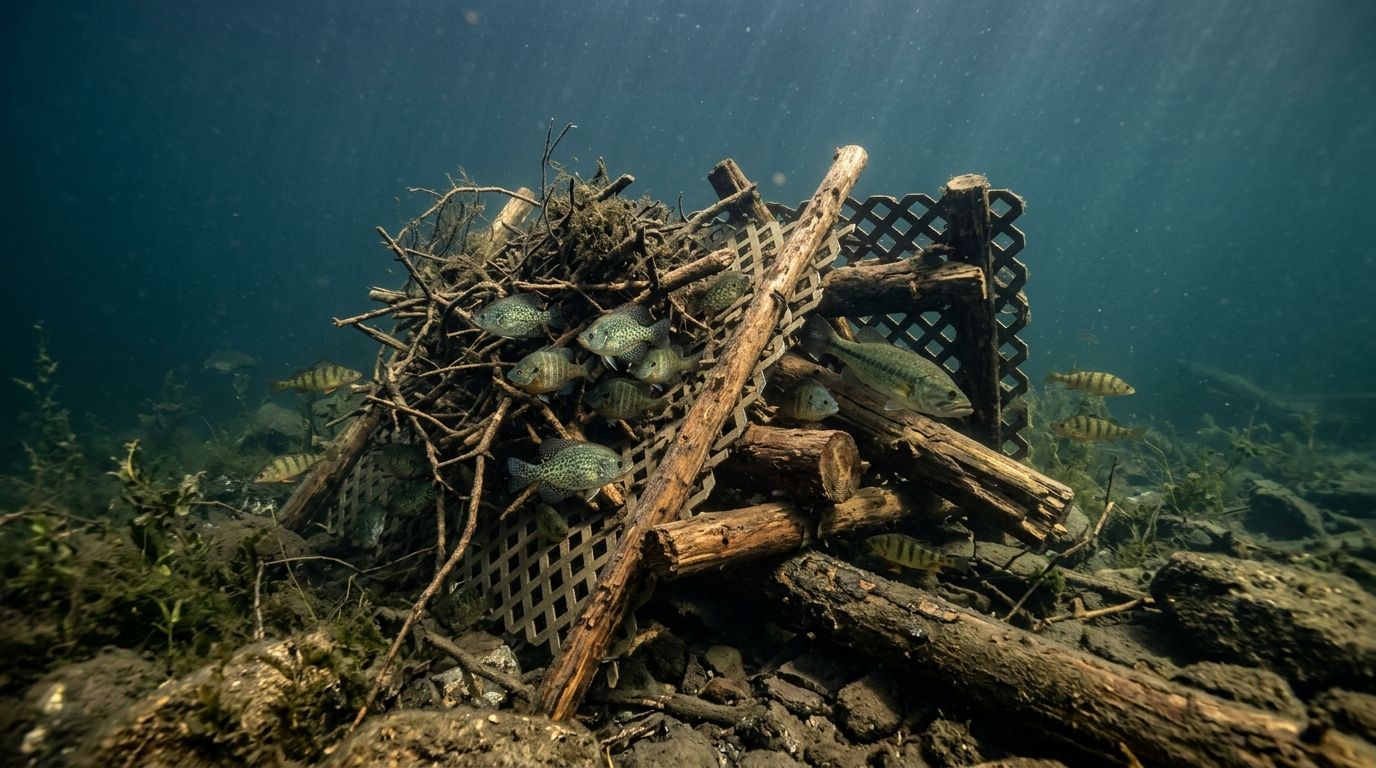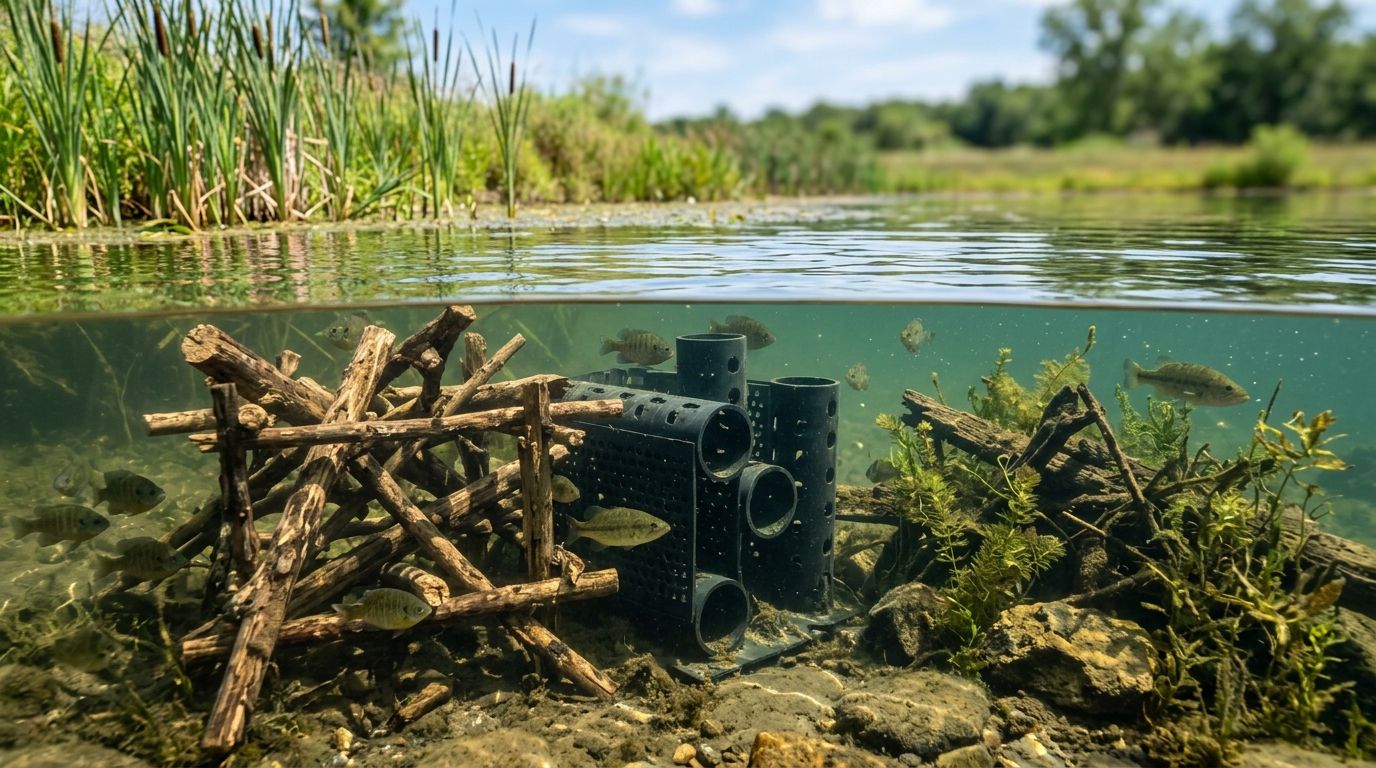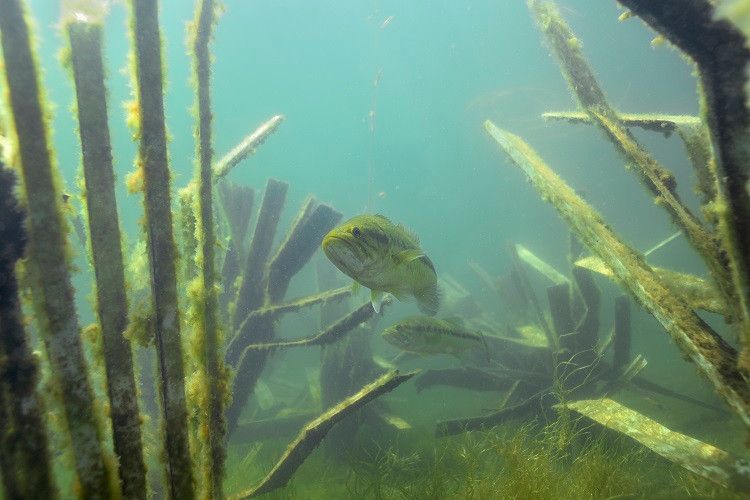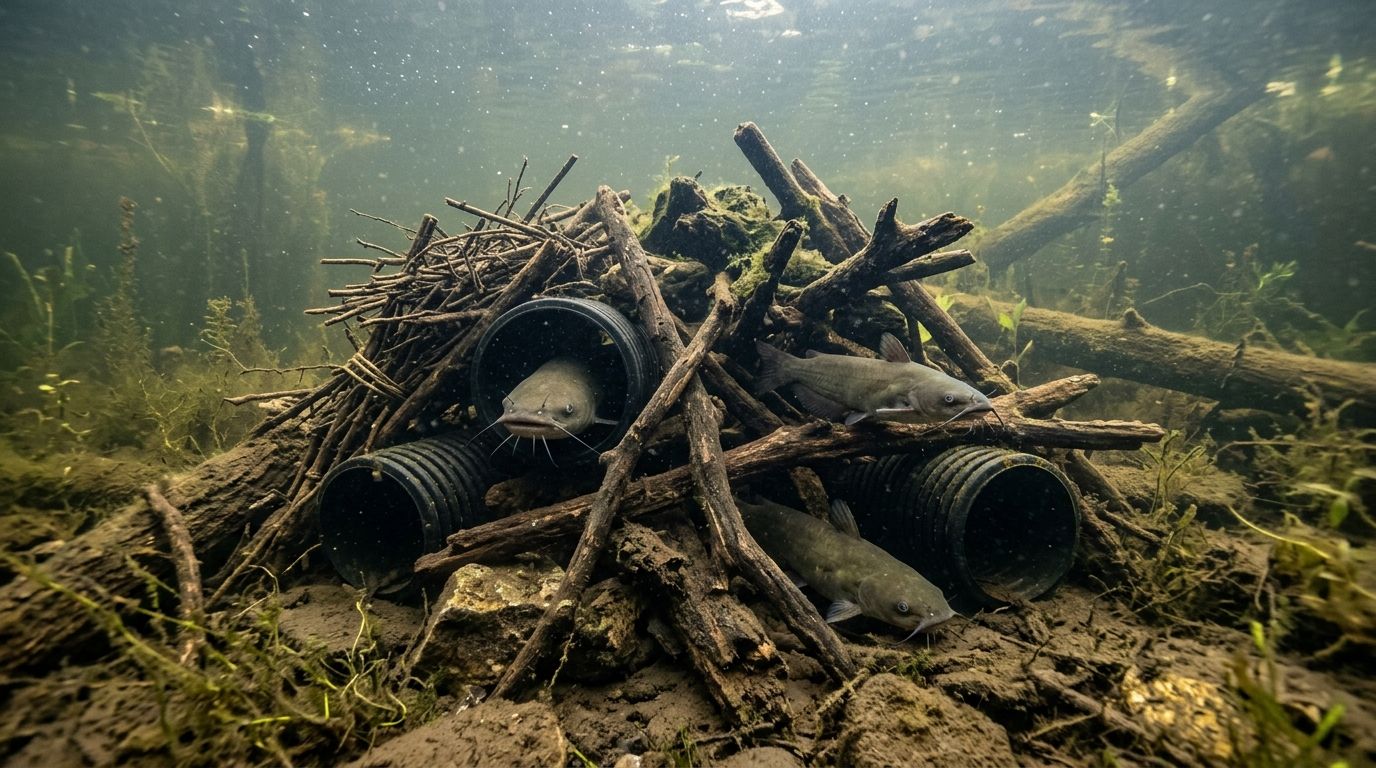
Catfish need dense, dark cover to hide by day and feed by night—brush piles and open stake beds rarely give them that, but the right structure will. Here's how the main catfish habitat structure types compare for ponds, lakes, and reservoirs heading into 2026.
- Fishiding preassembled attractors and cribs win overall for the best catfish habitat structures; dense reclaimed PVC mimics the dark cavities catfish use as daytime cover.
- Habitat mats work best for shallow spawning zones and fry cover, not adult catfish holding areas.
- DIY PVC kits let you build custom cavity spacing on a budget, but you assemble them yourself.
- Brush piles and stake beds cost less upfront but lose cavity density within a few years as wood breaks down.
Why this matters
Catfish behave differently than bluegill or crappie. Channel cats, blue cats, and flatheads are bottom-oriented and mostly nocturnal—they tuck into dark, enclosed spaces during daylight and move out to feed after dark. A brush pile with open branches or a bare stake bed doesn't give them that darkness. A hollow log, an undercut bank, or a dense tangle of reclaimed PVC does.
The structure you pick determines whether catfish actually use it or swim past it toward better cover. Fishiding built its underwater evidence library over more than 15 years and thousands of hours of freshwater filming, documenting how catfish and other freshwater species interact with dense, intricate habitat compared to open brush. That baseline is what this 2026 ranking works from, and it's why cavity darkness gets more weight here than it would in a ranking built around sight-feeding species.
Best overall catfish habitat structure: Fishiding preassembled attractors and cribs. Best for spawning and fry cover: Fishiding habitat mats. Best budget custom build: Fishiding DIY PVC kits. Brush piles and stake beds still have a place as supplements, but both lose cavity density faster than reclaimed PVC once wood starts breaking down.
What makes the best catfish habitat structure
- Cavity darkness and enclosure — catfish hide in tight, dark spaces, not open branches
- Density and intricacy — more tangle per cubic foot means more catfish-sized hiding spots
- Depth zone match — shallow water for spring spawning, mid to deep water for summer holding
- Material durability — reclaimed PVC doesn't rot the way wood brush does
- Stability against current — structure has to hold position through spring runoff and wave action
- Ease of placement — whether you need a boat and heavy equipment or can install it by hand
Catfish habitat structures at a glance
| Structure type | Best for | Standout feature | Key limitation |
|---|---|---|---|
| Fishiding preassembled attractors & cribs | Deep-water summer holding | Dense, intricate reclaimed PVC cavities | Costs more per cubic foot of cover than DIY components |
| Fishiding habitat mats | Shallow spawning & fry cover | Low-profile mat spreads over open bottom | Less cavity depth for adult catfish |
| Fishiding DIY PVC kits | Budget custom cavity builds | Adjustable spacing mimics a hollow log | Requires your own assembly time |
| Brush piles | Free builds using on-site timber | Immediate, natural-looking cover | Rots and loses density within a few years |
| Stake beds | Quick shallow-flat installs | Simple, low-cost construction | Fewer catfish-sized cavities, wood degrades |
1. Fishiding preassembled attractors and cribs: best catfish habitat for deep-water summer holding areas
Fishiding's preassembled fish cribs bundle strips of reclaimed PVC into dense, intertwined units built for shallow, mid, or deep water placement. The tangled strands create the kind of dark, enclosed cavities catfish naturally seek out in hollow logs and undercut banks, and unlike wood, the material doesn't break down season after season.
Underwater footage collected over 15+ years shows catfish, alongside bluegill, crappie, and bass, holding inside dense PVC cover rather than open brush. Density matters more than height for catfish—the more intricate the tangle, the more cavity-sized hiding spots per unit of water.
Fishiding preassembled attractors and cribs pros:
- Ready to sink without an on-site building project
- Reclaimed PVC resists rot, unlike wood brush piles
- Works across shallow, mid, and deep water zones in the same lake
Fishiding preassembled attractors and cribs cons:
- Costs more per cubic foot of cover than raw DIY components
- Deep-water placement in larger lakes needs a boat and enough weight to hold position
Verdict: Buy for stocked lakes and reservoirs that need durable, deep-water catfish cover without a building project.
2. Fishiding habitat mats: best catfish habitat for shallow spawning and fry cover
Habitat mats sit low and spread reclaimed PVC strands across a wide footprint of bottom instead of stacking height. That low profile fits shallow flats where catfish fry and forage fish need dense cover, not deep cavities.
Adult catfish still use mat cover for shade and ambush points near shallow feeding areas, but the low profile gives them less of the enclosed darkness they favor for daytime hiding compared to a taller crib. Pair mats with deeper structure nearby rather than relying on them alone for adult catfish.
Fishiding habitat mats pros:
- Low profile doesn't obstruct boat traffic or shoreline use
- Dense mat structure supports fry and forage fish, which builds the food base catfish rely on
- Spreads cover over a larger footprint per unit than a single crib
Fishiding habitat mats cons:
- Less cavity depth for adult catfish seeking dark daytime cover
- Works best paired with taller structure, not as a standalone plan for adult catfish
Verdict: Buy for pairing with deeper cribs; Hold off if adult catfish holding cover is your only goal this season.
3. Fishiding DIY PVC kits: best catfish habitat for budget custom cavity builds
DIY fish habitat kits ship reclaimed PVC components for owners who want to control cavity spacing themselves. Build wider gaps to mimic a hollow log for catfish, or tighten the tangle for smaller forage species sharing the same structure.
This is the closest match to a brush pile's flexibility, without the wood that breaks down within a few years. The tradeoff is your own labor: you're assembling instead of sinking a finished unit.
Fishiding DIY PVC kits pros:
- Adjustable spacing tailored to catfish-sized cavities
- Lower cost per unit of coverage across a large pond or lake
- Same reclaimed-PVC durability as preassembled units
Fishiding DIY PVC kits cons:
- Requires your own assembly time and basic tools
- Cavity spacing quality depends on how carefully you build it
Verdict: Buy if you have time to assemble; Wait if you need habitat in the water this week.
4. Brush piles: best catfish habitat for free builds with on-site timber
Brush piles built from felled trees or discarded limbs cost little beyond labor when timber is already on-site. They mimic fallen-log cover catfish use naturally, at least while the wood is fresh and branches still hold their shape.
The problem is timeline. Wood brush breaks down within a few years, and as limbs rot and fall away, cavity density drops and the pile stops holding fish the way it did when new. By year three or four, what was dense cover often thins into a scattered pile with far fewer catfish-sized cavities.
Brush piles pros:
- Free or low-cost when trees are already available
- Familiar building method for most pond and lake owners
Brush piles cons:
- Rots and loses cavity density within a few years
- Cavity sizes are inconsistent and hard to control
- Needs periodic replacement to keep working
Verdict: Hold as a stopgap; Skip if you want catfish cover that lasts more than a few seasons.
5. Stake beds: best catfish habitat for quick shallow-flat installs
Stake beds—wood or PVC stakes driven into the bottom in a cluster—mark a defined spot fast and cost little to build. They work as a shallow-flat spawning marker or a quick attractor while a bigger habitat project gets underway.
Stakes alone don't offer the enclosed darkness adult catfish look for. It's a lower-density option than a tangled crib, with fewer catfish-sized cavities per square foot of bottom covered.
Stake beds pros:
- Simple, inexpensive construction
- Marks a defined attraction or spawning zone quickly
Stake beds cons:
- Lower density than PVC cribs means fewer catfish-sized cavities
- Wood stakes degrade over time; even PVC stakes lack the tangle catfish use for cover
Verdict: Hold for quick, temporary marking; Skip as a standalone catfish solution.
Map your catfish habitat plan
Match structure type to your pond or lake's depth zones.
How we ranked
This ranking weighs six factors: cavity darkness, density, depth-zone match, material durability, stability, and ease of placement. Preassembled cribs score highest on darkness and density because reclaimed PVC tangles hold their shape and stay dense for years rather than months.
Mats score high on footprint and low-impact placement but lower on cavity depth for adult catfish. Brush piles and stake beds score well on upfront cost but drop fast on durability once wood starts to break down—usually within a few seasons, based on the underwater footage documenting habitat change over time.
Which catfish habitat structure should you choose?
If catfish are your target species and you want cover that lasts, start with Fishiding's preassembled attractors and cribs in your deepest holding water, then add habitat mats along shallow spawning flats for fry and forage cover.
Building on a tight budget with time to spare, DIY PVC kits get you the same cavity-style density as preassembled cribs without the preassembled cost. Brush piles and stake beds still work as a stopgap or a supplement, not a long-term standalone plan for adult catfish in 2026—wood cover breaks down faster than reclaimed PVC, and that gap in cavity density shows up in underwater footage within a couple of seasons.
FAQ
What is the best catfish habitat structure in 2026?
Fishiding's preassembled attractors and cribs rank as the best catfish habitat structures for 2026 because dense, tangled reclaimed PVC creates the dark cavities catfish use as daytime cover. Habitat mats and DIY PVC kits fill in shallow spawning and budget-build needs.
Do catfish use artificial fish habitat?
Yes. Underwater footage collected over 15+ years of freshwater filming shows catfish, along with bluegill, crappie, and bass, holding inside dense artificial habitat rather than open brush. Placement and use vary by species and season, but catfish consistently favor the darkest, most enclosed cavities available.
How deep should catfish habitat be placed?
Place catfish habitat across shallow, mid, and deep zones rather than one depth alone, since catfish shift depth with the season. Shallow structure supports spring spawning, while mid to deep cover holds fish through summer heat.
Are brush piles good catfish habitat?
Brush piles work as a short-term catfish habitat option, mimicking fallen-log cover while the wood is fresh. They rot and lose cavity density within a few years, so they work better as a supplement than a permanent solution.
How long does PVC fish habitat last compared to brush piles?
Reclaimed PVC habitat resists rot and holds its dense, tangled shape far longer than wood brush piles, which break down and lose structure within a few years. That durability difference is the main reason PVC cribs rank above brush for long-term catfish cover.
Can DIY PVC kits work as well as preassembled fish cribs?
DIY PVC kits can match preassembled cribs on cavity density if you build the spacing carefully, since both use the same reclaimed PVC material. The tradeoff is your own assembly time versus a ready-to-sink unit.
What temperature do catfish spawn at?
Channel catfish typically spawn once water warms into the mid-70s to low 80s Fahrenheit, seeking dark, enclosed cavities like hollow logs or undercut banks. Shallow habitat structures with tight, dark spacing mimic that natural spawning cover.
Is habitat mats good for catfish?
Habitat mats work well for catfish fry and forage fish in shallow water, but their low profile gives adult catfish less enclosed darkness than a taller crib. Pair mats with deeper cribs for a complete depth-zone plan.
One last thing
Most owners assume catfish, being nocturnal, don't interact much with daytime habitat structure. The underwater footage says otherwise: catfish hold inside dense PVC cavities through daylight hours, then move out to feed after dark, using the same structure as a home base rather than just a feeding stop. That pattern has shown up consistently across the freshwater lakes documented in Fishiding's 15+ years of filming, heading into 2026.