Best overall for a stocked bass pond in 2026: a mixed cluster of dense nursery cover and taller ambush structure placed across a useful depth change. A single open attractor can concentrate adult bass, but it does not give fry and forage fish the tight refuge that supports the whole food chain. Fishiding’s bass habitat observations show why density, variety, height and location matter more than a tidy shape.
- The best fish structure for stocked bass ponds combines dense refuge, open ambush edges and several depths.
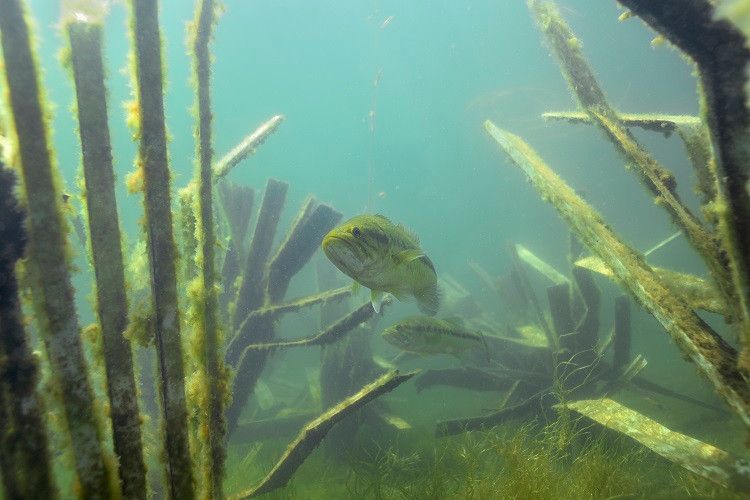
- Fishiding underwater observations show forage fish hiding inside dense cover while largemouth bass patrol the perimeter.
- Use Safehouse for mid-depth structure, Fortress for quick placement and shallow dense cover for fry.
- Place structures in clusters on firm bottom; isolated units and buried bases waste useful height.
Why this matters in a stocked bass pond
Stocking adds fish. Habitat determines where those fish can shelter, forage and hold through changing conditions. A pond with only adult-sized openings may create a fishing spot, but it leaves small fish exposed and limits the cover available to different life stages.
Fishiding has more than 15 years and thousands of hours of freshwater underwater filming. Those observations repeatedly show small fish using tight interior spaces while larger bass stage around the outside, use shade and hold near broad horizontal or angled surfaces. The strongest 2026 pond plan therefore uses several forms of cover together rather than asking one structure to do every job.
What makes the best fish structure for stocked bass ponds
Use these six checks before choosing any structure in 2026:
- Interior density: Small fish need openings that larger predators cannot enter.
- Useful height: Structure should rise far enough from the bottom to give fish choices in the water column.
- Mixed profiles: Fine strands, broad limbs, vertical pieces and horizontal ambush surfaces serve different functions.
- Correct depth: Shallow habitat supports fry and organic growth; deeper cover can provide seasonal holding areas when oxygen is adequate.
- Stable placement: A structure that tips, rolls or sinks into muck loses usable shape and height.
- Cluster size: Several nearby units create a larger habitat complex than isolated pieces scattered around the pond.
Best bass-pond structure at a glance
| Rank | Structure | Best for | Standout feature | Main limitation |
|---|---|---|---|---|
| 1 | Mixed-density habitat cluster | Best overall pond system | Combines refuge, forage and ambush zones | Requires a placement plan and several pieces |
| 2 | Fishiding Safehouse | Mid-depth transition cover | Broad, bendable limbs with a dense center | One unit cannot cover every depth zone |
| 3 | Fishiding Fortress | Fast deployment | Self-opening reclaimed-PVC structure | Fixed scale is less customizable than a DIY cluster |
| 4 | Shallow dense nursery cover | Fry and forage protection | Tight spaces near the productive shoreline zone | Must stay clear of navigation and seasonal exposure |
| 5 | Brush and woody cover | Natural-material supplement | Irregular shape and immediate complexity | Fine branches break down and density declines |
1. Mixed-density habitat cluster: best overall for stocked bass ponds
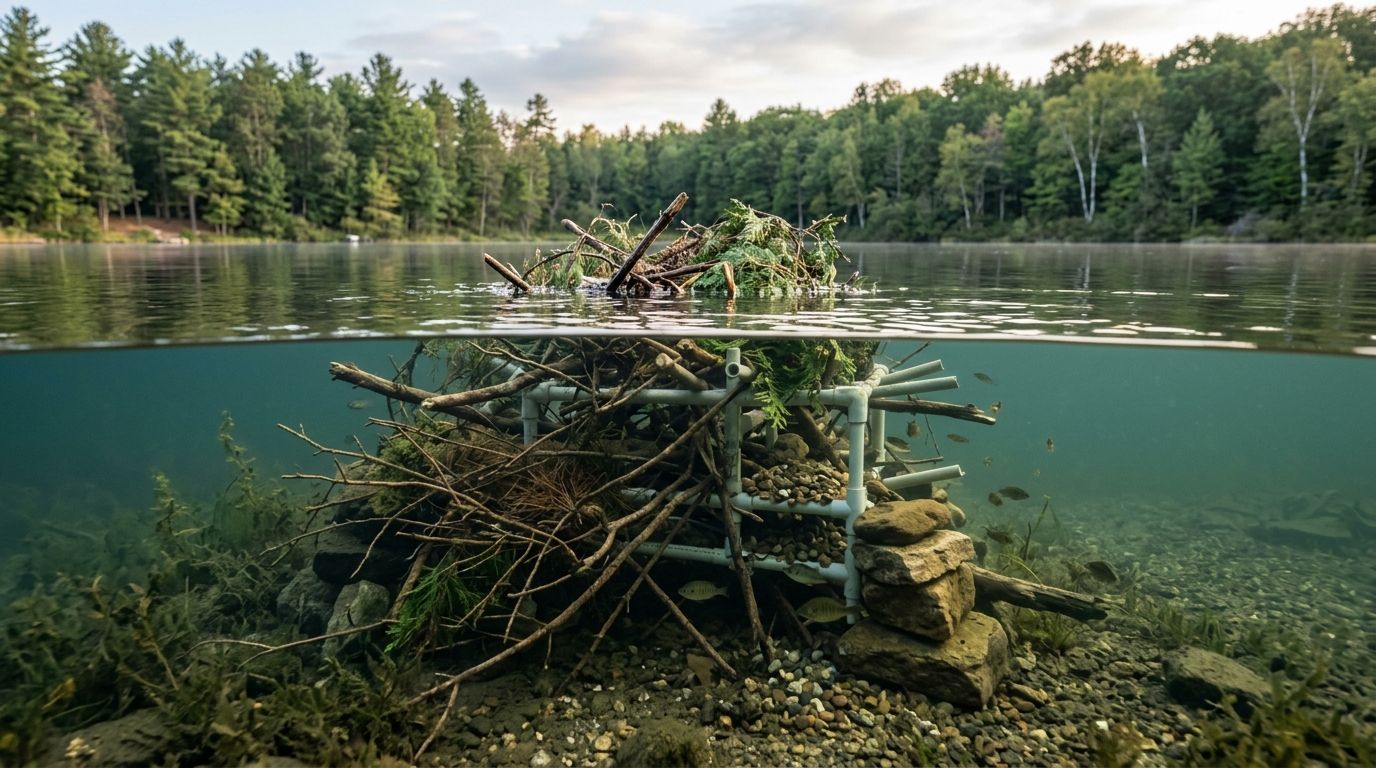
A mixed cluster places dense shallow refuge beside medium and taller structure instead of scattering identical units around the pond. This creates small interior spaces for fry, intermediate openings for panfish and forage species, and outside edges where bass can stage.
Mixed-density cluster pros:
- Serves several fish sizes and life stages.
- Creates shade, refuge, travel edges and ambush positions.
- Lets you match structure height to the pond’s contour.
- Can blend reclaimed PVC with existing vegetation or woody cover.
Mixed-density cluster cons:
- Takes more planning than dropping one attractor.
- Poor placement can leave part of the cluster too deep, buried or seasonally exposed.
- Multiple pieces cost more or take more building time than a single unit.
Best for: Pond owners making one habitat investment and wanting it to serve the forage base as well as adult bass.
Verdict: Buy when the pond lacks varied cover. In 2026, this is the strongest default because it treats habitat as a system rather than a single fishing marker.
2. Fishiding Safehouse: best mid-depth bass structure
The Fishiding Safehouse stands 48 inches tall, weighs about 16 pounds and opens to more than 7 feet wide. Its reclaimed-PVC limbs range from about 3 to 6 inches wide, giving the structure medium texture, shade and broad surfaces around a dense center.
Bend the limbs in several directions instead of making a symmetrical tree. Angled and overlapping pieces create smaller pockets inside, while the outer limbs give bass places to hold. The self-weighted base keeps the unit upright when placed on a suitable bottom.
Safehouse pros:
- Wide footprint from one preassembled unit.
- Bendable limbs let you change height, density and profile.
- Medium texture works between fine nursery cover and large open structure.
- Reclaimed PVC materials were diverted from landfill disposal.
Safehouse cons:
- It still needs correct shaping and placement.
- A soft bottom can swallow part of the base and reduce effective height.
- A lone Safehouse offers less habitat variety than a mixed group.
Best for: Mid-depth transition zones where shallow forage cover meets deeper bass travel water.
Verdict: Buy as the central unit in a cluster, not as the only habitat in the pond.
3. Fishiding Fortress: best structure for fast placement
The Fishiding Fortress is a 45-inch self-opening structure designed for roughly 3 to 8 feet of freshwater. Fine strands fill the middle, while the larger outside pieces provide a broader profile. It opens without the full hand-shaping required by bend-by-hand models, though individual pieces can still be adjusted.
Fortress pros:
- Self-opening design reduces setup time.
- Fine center and wider outside elements create contrasting spaces.
- Fits common shallow-to-mid-depth pond zones.
- Reclaimed PVC gives the installation a lasting structural framework.
Fortress cons:
- Less custom shaping than a loose-material build.
- Its 45-inch height must still fit the chosen depth and water-level range.
- Repeating only one model produces less variety than mixing profiles.
Best for: Pond owners who need to place several structures efficiently.
Verdict: Buy for quick cluster building, then pair it with denser shallow cover.
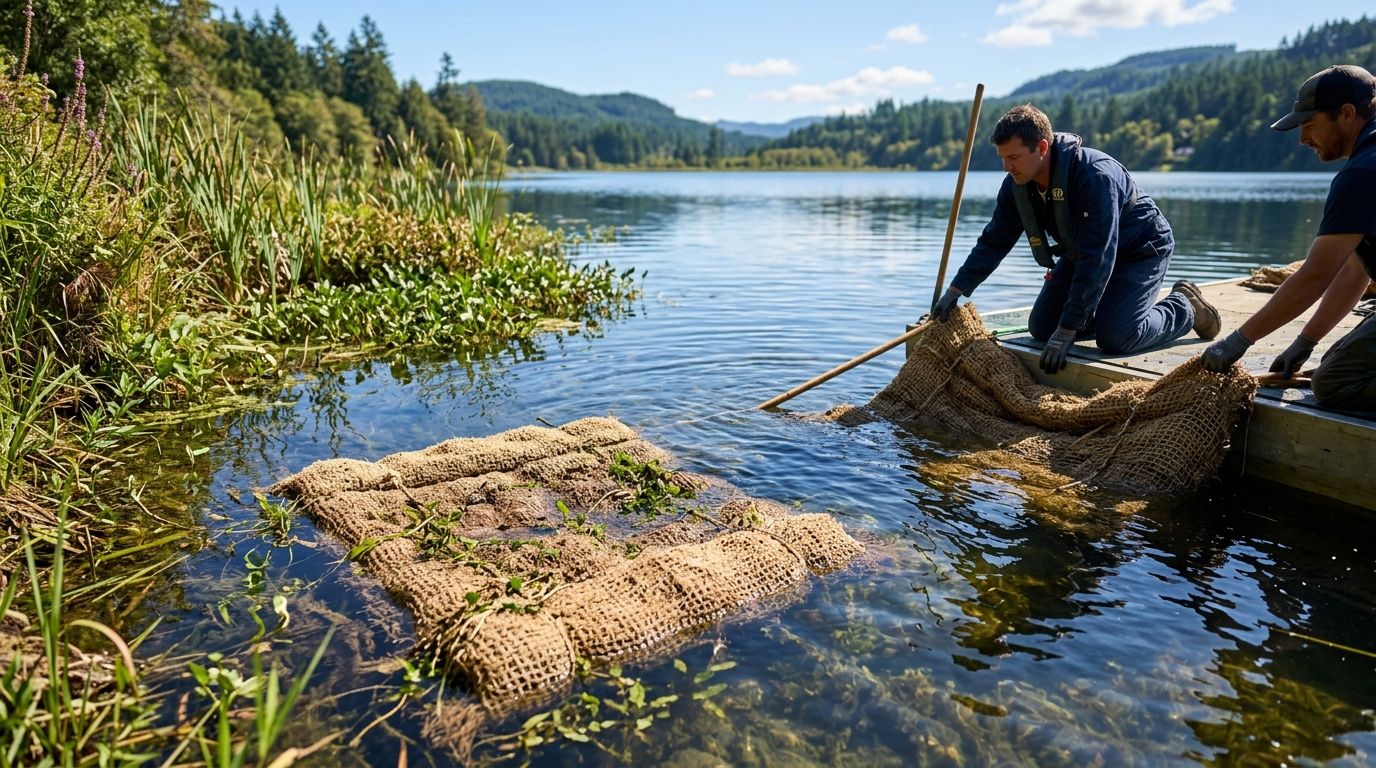
4. Shallow dense nursery cover: best for bass fry and forage fish
The shallow zone is where young fish can reach tight cover and where sunlight can support algae and other attached growth. Fishiding’s underwater observations show that dense, intricate spaces matter because small fish can enter areas that adult bass cannot.
The Cradle, Briar and Bunker models fill this role with fine or closely spaced reclaimed-PVC elements. Place shallow pieces where they remain submerged at normal low water and do not create a boating, swimming or maintenance hazard.
Shallow nursery cover pros:
- Protects small fish with predator-resistant openings.
- Adds density near spawning and early-life areas.
- Can connect shoreline cover to mid-depth structure.
- Gives the pond plan a function beyond concentrating catchable bass.
Shallow nursery cover cons:
- Water-level changes can expose it.
- Very shallow placements require careful marking and site awareness.
- It does not replace the taller structure adult bass use farther out.
Best for: New or renovated stocked ponds with limited vegetation and little refuge for fry.
Verdict: Buy before adding more open attractors. Protecting the forage base is the first habitat gap to close.
5. Brush and woody cover: best natural-material supplement
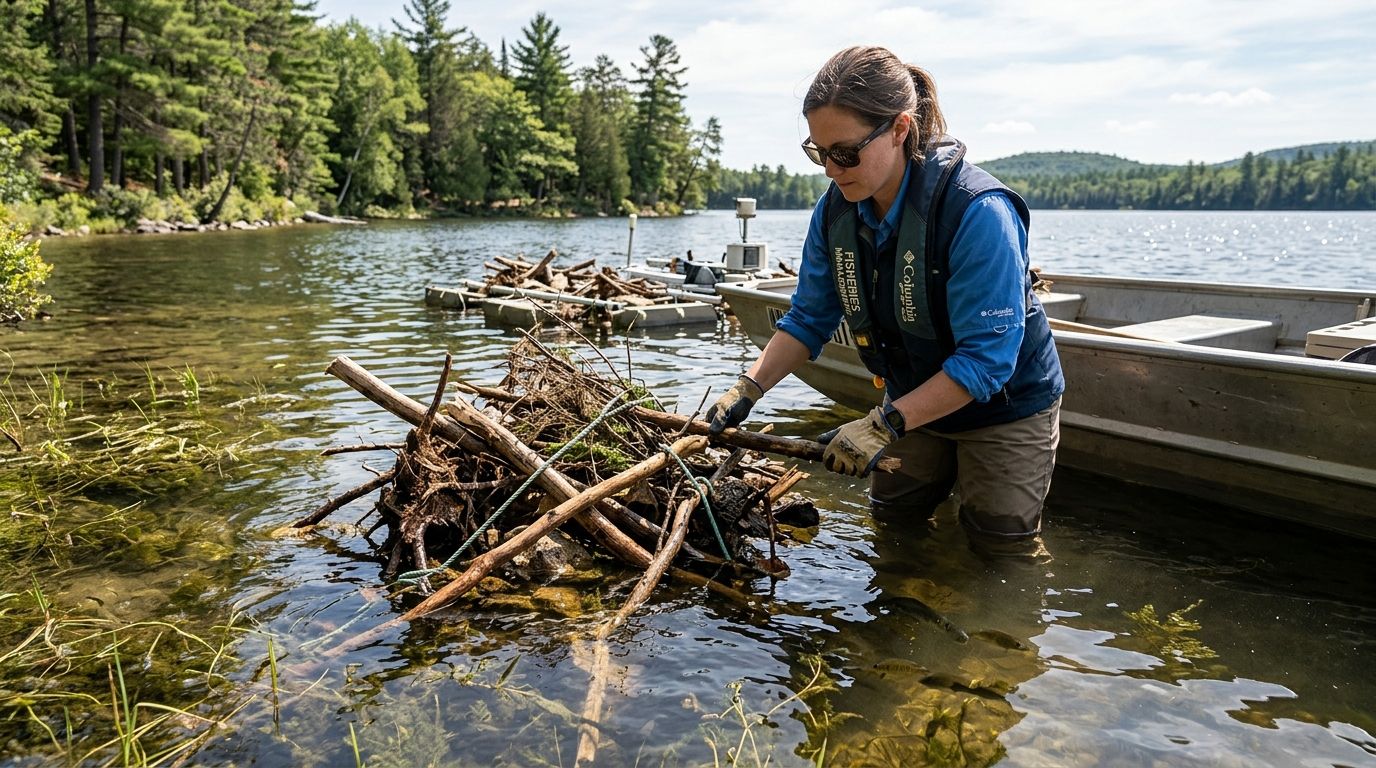
Brush piles and submerged wood provide irregular branches, shade and familiar structure. Fishiding’s guide to artificial fish habitat versus simple fish attractors explains why lasting interior density matters as natural material breaks down. Fresh, tightly packed brush can create excellent small-fish cover, especially when paired with taller trunks or limbs that reach into the water column.
The weakness appears over time. Fishiding’s long-running fish crib observations found that fine interior brush breaks down faster than the outer frame. Once that dense center disappears, small fish lose refuge and larger fish have less reason to remain nearby.
Brush and woody cover pros:
- Uses natural shape and local material.
- Can provide immediate complexity when packed densely.
- Blends well with existing shoreline or fallen-tree habitat.
- Works as part of a mixed artificial-and-natural complex.
Brush and woody cover cons:
- Fine branches decay and interior density declines.
- Heavy bundles are difficult to place and reposition.
- Loose material can move, snag or create access problems.
Best for: Pond owners with suitable natural material who can maintain or supplement it.
Verdict: Hold as part of the plan, but do not rely on aging brush as the pond’s only long-term refuge.
How to place fish structure in a stocked bass pond
1. Map the pond before buying
Mark the shoreline, points, drop-offs, firm-bottom areas, vegetation and normal low-water line. Note where fish already have usable natural cover. New structure produces more value in barren zones than directly beside an existing tree, dock or weed bed.
2. Build a depth sequence
Start with dense shallow cover for fry. Connect it to medium structure across a gentle break, then add taller or more open pieces near deeper travel water. This sequence gives fish options as temperature, light and seasonal behavior change.
3. Choose firm bottom
Avoid deep muck when possible. If a base settles into 12 inches of soft sediment, the pond effectively loses 12 inches of useful structure height. Firm substrate also makes the finished placement easier to map and revisit.
4. Group structures instead of scattering them
Fishiding observations consistently favor a larger constellation over isolated units. Several nearby pieces create a recognizable complex with interior refuge, perimeter edges and routes between profiles. Leave enough room to fish the outside without opening large predator lanes through the nursery core.
5. Shape every piece for function
Do not aim for neat symmetry. Fold broad limbs across each other, preserve narrow pockets in the center and leave some outside planes for adult bass. Fishiding’s installation guidance explains how bendable models can be shaped in less than 5 minutes and how self-opening models deploy.
How Fishiding ranked these choices
Fishiding’s evidence comes from more than 15 years and thousands of hours of freshwater underwater filming. Those observations document how fish use dense centers, angled panels, natural growth, perimeter edges and clustered structures. They do not mean every pond will produce the same result; depth, oxygen, water clarity, forage balance and existing cover still shape use.
Which fish structure should you choose?
Choose a mixed-density cluster if you want the strongest overall answer in 2026. Put dense cover first, add a Safehouse or Fortress through the middle zone, and retain useful natural wood or vegetation where it already works.
Choose the Safehouse when you need one adaptable mid-depth unit. Choose the Fortress when fast multi-unit deployment matters. Choose shallow Cradle-, Briar-, Bunker- or mat-style cover when young fish lack refuge.
The best fish structure for stocked bass ponds is not the biggest object; it is the most useful combination of tight refuge, vertical cover and fishable edges placed where the pond can support it.
FAQ
What is the best fish structure for a stocked bass pond?
A mixed cluster of dense shallow refuge, medium transition cover and taller ambush structure is the best overall choice. It serves fry, forage fish and adult bass instead of concentrating only catchable fish.
How deep should bass habitat be placed?
Place habitat across several useful depths rather than at one fixed depth. Keep shallow nursery cover submerged at low water, and confirm deeper sites retain enough oxygen for seasonal fish use.
Is PVC fish habitat better than brush piles?
Reclaimed-PVC habitat keeps its structural framework while fine brush naturally breaks down. Brush remains useful as a natural supplement, but a mixed installation preserves interior complexity longer.
Should fish attractors be placed alone or in groups?
Place fish attractors in groups when the site allows it. Fishiding underwater observations show clusters create more varied interior cover and perimeter edges than isolated units.
Does fish structure grow bigger bass?
Fish structure provides shelter, feeding edges and places for fish to hold, but it is one part of pond management. Forage balance, water quality, stocking and harvest decisions also affect bass growth.
How do I know whether pond habitat is working?
Look for repeated use of the interior, perimeter and nearby water by several fish sizes. One catch near a structure does not prove the habitat is protecting forage fish or holding fish consistently.
What bottom is best for artificial fish habitat?
Firm bottom is best because it preserves the structure’s full height and shape. Soft muck can bury the base and reduce the amount of habitat available above the pond floor.
One last thing
Do not place new structure only where you already catch bass. In 2026, the better test is whether a previously barren but suitable zone begins supporting forage fish and bass after installation. That shows the pond gained usable habitat instead of merely adding an object to an existing fishing spot.