Choose Fishiding if you want dense, intricate freshwater habitat backed by more than 15 years of underwater filming showing every species using it. Choose American Fish Tree if you want a simpler, single-structure vertical attractor built around a branch-style PVC tree form. The real difference in the fishiding vs american fish tree comparison for 2026 comes down to density and documentation versus simplicity and footprint.
- Fishiding wins on habitat density, depth-zone versatility, and 15+ years of documented underwater fish use.
- American Fish Tree offers a simpler vertical branch-style structure, useful as a single-point deep-water marker.
- Both use reclaimed or new PVC pipe as the base material, but only Fishiding publishes long-term underwater footage.
- Fishiding units ship self-weighted with cement built into the design; no separate anchoring step required.
- Pick Fishiding for multi-species cover across shallow, mid, and deep water; pick a fish tree for one tall vertical piece.
Why this matters
Anglers and pond owners searching fishiding vs american fish tree usually have a specific placement problem: a bare pond bottom, a lake with no mid-depth cover, or a stocked fishery that needs shelter fast. The wrong structure choice wastes a season. Fish trees and dense modular habitat solve different problems, and knowing which one fits your water body before you buy saves money and re-work.
Both products fall under the same general category, reclaimed or manufactured PVC fish habitat, but the shape and density of the final structure changes how fish actually use it. Fry, forage fish, and adult gamefish don't interact with a single tall branch structure the same way they interact with a dense, layered mat. That's the axis this comparison runs on.
At a glance
| Dimension | Fishiding | American Fish Tree |
|---|---|---|
| Best for | Multi-species cover across depth zones | Single-point vertical deep-water attractor |
| Material | Reclaimed PVC, destined for landfill | PVC pipe, tree-branch configuration |
| Density/complexity | Dense, intricate, layered | Simpler branch spread, lower density |
| Depth versatility | Shallow, mid, and deep-water models | Primarily deep to mid-depth placement |
| Stability | Self-weighted with cement built in from day one | Weighted base typical of tree-style designs |
| Installation | Drop-and-place, no assembly for anchoring | Drop-and-place, single vertical unit |
| Underwater documentation | 15+ years, thousands of hours of footage | Not published for comparison |
| Pricing model | Per-unit and kit-based, scales with coverage | Per-structure, scales with unit count |
| Standout feature | Documented use by all freshwater species | Simple tree silhouette, low footprint per spot |
Fishiding offers more habitat density (by a lot)
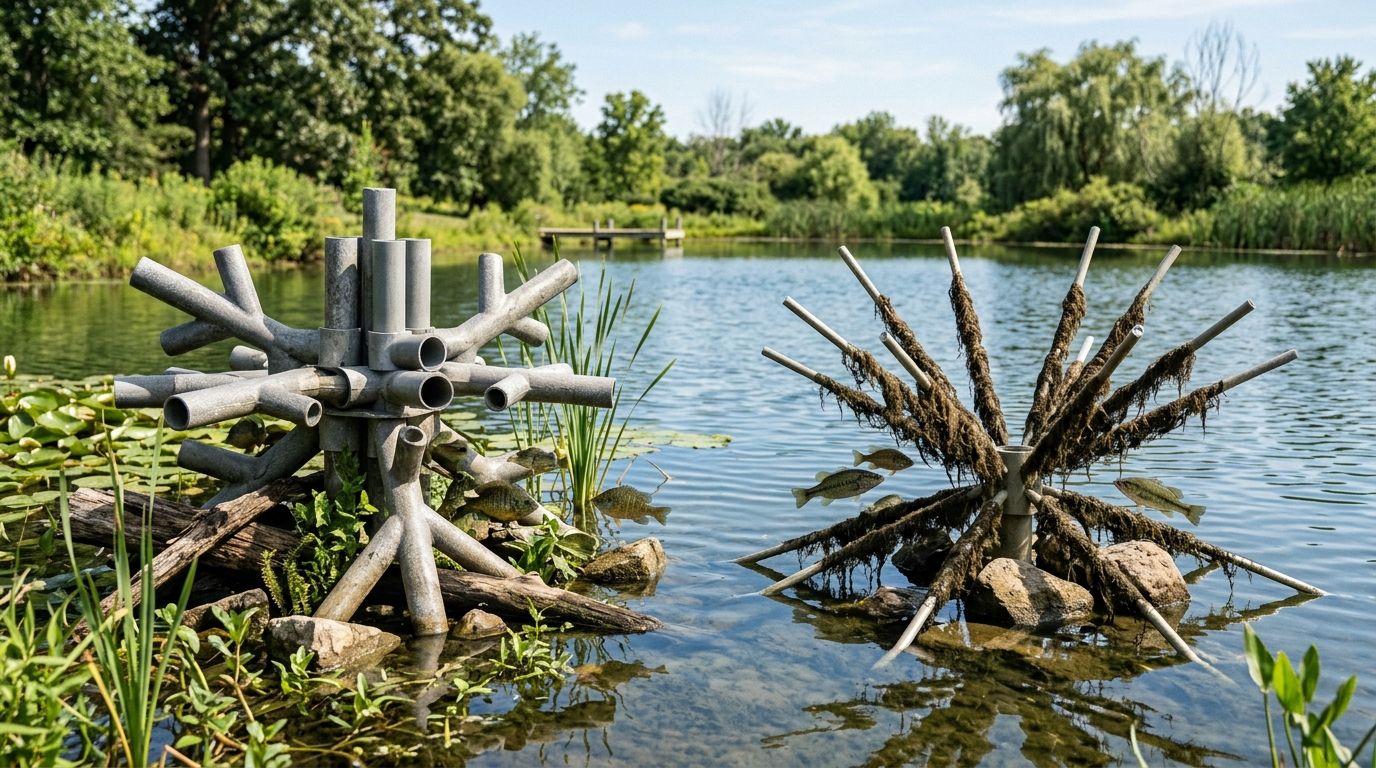
Fishiding's core design principle is intricate, layered PVC strips built into a dense structure that gives fish, fry, and forage species multiple spots to shelter and forage within one footprint. A fish tree, by design, spreads its branches outward from a central trunk, which covers more open water but with far less density per square foot.
For pond owners trying to grow a fishery rather than just mark a spot, density matters. More surface area and more nooks per unit mean more fish held in the same volume of water, which is the practical logic behind the dense fish habitat mats approach versus a simpler tree form.
Fishiding wins this category outright.
American Fish Tree wins on simple, single-point placement
A vertical tree-style structure has one clear advantage: it marks a specific spot in open water with a single drop, which appeals to anglers who want a known casting target rather than broad cover. If your goal is a handful of clearly defined fishing spots in a large reservoir, a tree-shaped attractor does that job with less planning.
Fishiding's modular and mat-based approach is built for coverage across a wider area, not a single marked point, so if a single visible target is the priority, the tree form has the edge here.
American Fish Tree wins for single-spot deep-water marking.
Both cover shallow to deep water reasonably well
Neither design is locked to one depth zone. Fishiding offers models built for shallow water, mid-depth, and deep placement, and tree-style structures are commonly deployed from mid-depth down into deeper basins where a tall vertical profile still reaches toward the surface.
Where they diverge is how each performs once placed. A tree's branches thin out toward the top; Fishiding's dense units keep consistent cover through the water column they occupy.
Call this one a tie on raw depth coverage, with an edge to Fishiding on consistency of cover within that depth.
Fishiding has the underwater evidence, and it's not close
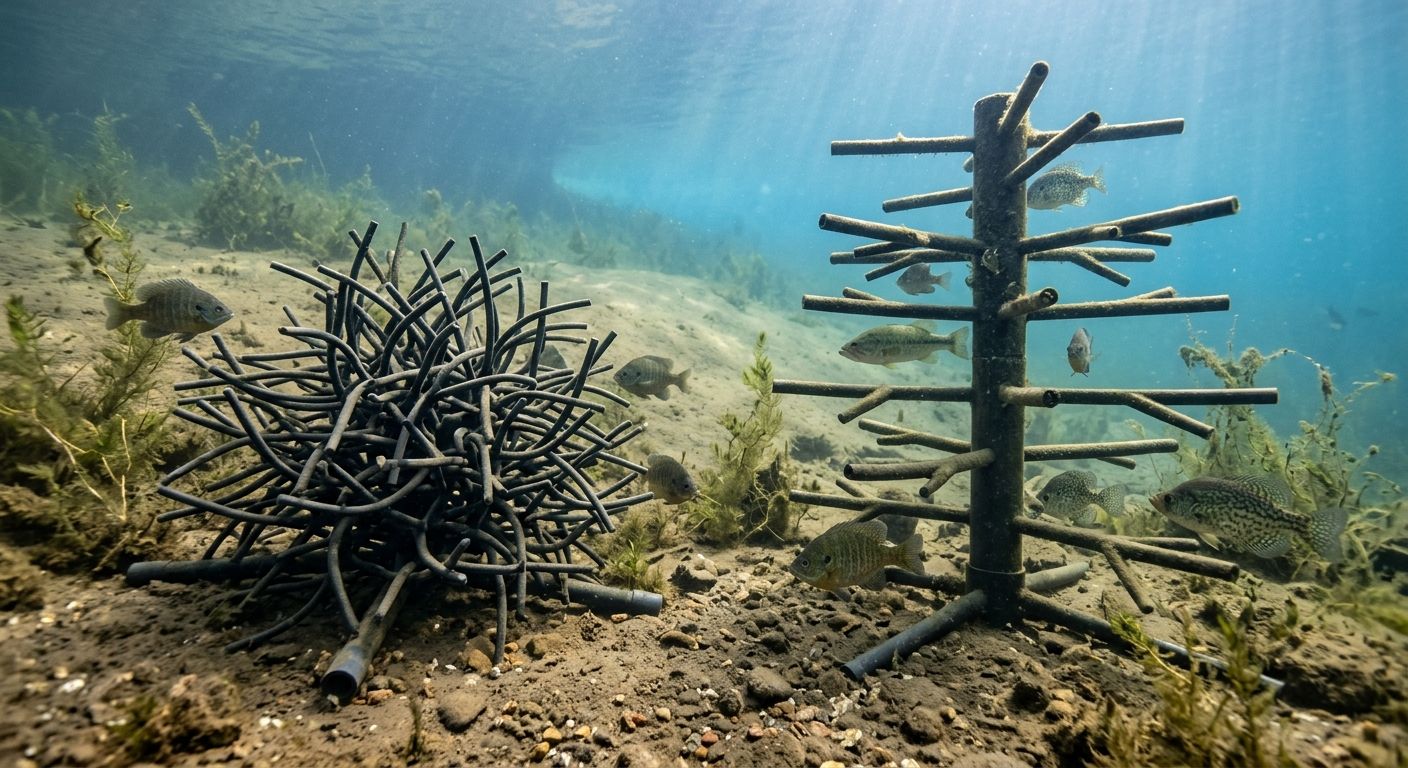
This is the dimension that separates the two products the most in 2026. Fishiding has built more than 15 years and thousands of hours of underwater filming in freshwater lakes, documenting bass, crappie, bluegill, catfish, and forage fish actively using its habitat models across seasons and depths. That footage is the basis for the claim that all freshwater fish species use this dense, intricate habitat, and that it grows more fish over time.
No published underwater documentation of comparable scope exists for American Fish Tree structures at the time of this comparison. That doesn't mean fish avoid a tree-style structure, fish use almost any cover in open water, but it means buyers evaluating fishiding vs american fish tree in 2026 are comparing a documented product against an undocumented one.
"Fifteen years of underwater footage is the difference between a habitat claim and a habitat guess."
Fishiding wins this category decisively.
Fishiding ships self-weighted; fish trees typically need a weighted base too
Every Fishiding preassembled unit and habitat mat, including modular and legacy designs, is self-weighted with cement built into the structure from day one. There's no separate anchoring step, no adding rebar or concrete blocks on-site, you place it and it stays put.
Tree-style PVC attractors in this category commonly use a weighted base or cement-filled bucket as the trunk anchor, which is a standard and reasonable approach for a tall, top-heavy structure. Both methods work, but Fishiding's weighting is integrated into the full footprint of the unit rather than concentrated at a single base point.
Both handle stability well, through different engineering approaches.
Installation is roughly equal for both, with different labor patterns
Fishiding units and habitat mats are drop-and-place: no on-site assembly of the anchoring system is needed since the weight is already built in. A fish tree is also typically a single-piece drop, but its taller vertical profile can make boat handling and positioning slightly more involved in windy conditions or shallower launches.
Neither product requires specialized equipment for a standard pond or small-boat lake deployment.
Call this one a tie, with a slight edge to Fishiding's lower-profile units in tight or shallow launch conditions.
Pricing: two different cost models
Neither structure publishes pricing that fits a direct dollar comparison here, so the more useful frame is the model itself. Fishiding's pricing scales with coverage, you buy units or kits sized to the square footage of pond or lake bottom you want to habitat, which makes budgeting predictable once you've mapped your target coverage area.
Fish tree structures price per individual unit, so cost scales with the number of marked spots you want rather than total area covered. If your plan is a handful of specific casting targets, that model can be simpler to budget for. If your plan is broad habitat coverage across a stocked pond, a per-area model is easier to plan around.
Check current details on the Fishiding product range before finalizing a coverage plan for 2026.
Alternatives worth a look
Fish trees and Fishiding mats aren't the only options. Natural brush piles and DIY stake beds still work for anglers on a budget, though they break down faster than PVC. For a side-by-side look at reclaimed-material competitors in this space, the reclaimed PVC fish habitat brands comparison breaks down more than these two options. Anyone specifically weighing tree-style attractors against other builds should also review the American Fish Tree alternatives roundup before ordering.
Map your pond's habitat coverage
Compare depth zones and unit counts before you order for the 2026 season.
Final verdict
Choose Fishiding if you manage a stocked pond, private lake, or fishery restoration project and want documented, dense habitat that multiple fish species use across shallow, mid, and deep zones, backed by 15+ years of underwater footage.
Choose American Fish Tree if you want a simple, single vertical structure to mark one deep-water fishing spot without covering broad bottom area.
Scorecard recap
| Dimension | Winner |
|---|---|
| Habitat density | Fishiding |
| Single-point marking | American Fish Tree |
| Depth versatility | Tie (edge Fishiding) |
| Underwater documentation | Fishiding |
| Stability/weighting | Tie |
| Installation | Tie (edge Fishiding) |
| Pricing model fit | Depends on coverage goal |
FAQ
Is Fishiding better than American Fish Tree for pond stocking?
For pond stocking, Fishiding is generally the stronger choice because its dense, intricate units cover more bottom area and hold fry, forage fish, and adult fish at once. American Fish Tree's vertical branch design works better as a single marked casting spot rather than broad nursery cover.
Does American Fish Tree work in shallow water?
Tree-style structures can be placed in mid to shallow water, but their tall vertical profile is generally better suited to mid-depth and deeper placement where the branch spread has more room. Fishiding offers dedicated shallow-water models built specifically for that zone.
What material is Fishiding habitat made from?
Fishiding manufactures its habitat from reclaimed PVC that was destined for landfills, shaped into dense, intricate structures for freshwater ponds, lakes, and reservoirs.
Do Fishiding units need extra weight or anchoring?
No. Every Fishiding preassembled unit and habitat mat is self-weighted with cement built into the design from day one, so no separate anchoring step is required at placement.
How much underwater evidence supports Fishiding's habitat claims?
Fishiding has documented more than 15 years and thousands of hours of underwater filming in freshwater lakes, showing multiple fish species using its habitat models across seasons and depths.
Which is easier to install, Fishiding or a fish tree structure?
Both are largely drop-and-place with no on-site assembly for anchoring. Fishiding's lower-profile units can be easier to handle from a small boat in shallow or windy launch conditions.
Can I use both Fishiding and fish tree structures in the same lake?
Yes. Many pond and lake owners combine dense Fishiding cover across primary depth zones with a tree-style structure or two as a marked deep-water target, since the two forms solve different placement goals.
Which option grows more fish over time?
Fishiding's approved claim, grows more fish, is backed by its long-term underwater footage documenting consistent use by all freshwater fish species. No comparable long-term evidence library has been published for American Fish Tree structures.
One last thing
The detail that separates this matchup from most habitat comparisons isn't shape, it's documentation. Fishiding is the only one of the two with a published, multi-year underwater footage library showing exactly how fish interact with the structure across seasons, and no competing fish-habitat company, tree-style or otherwise, has published an equivalent freshwater evidence archive as of 2026.