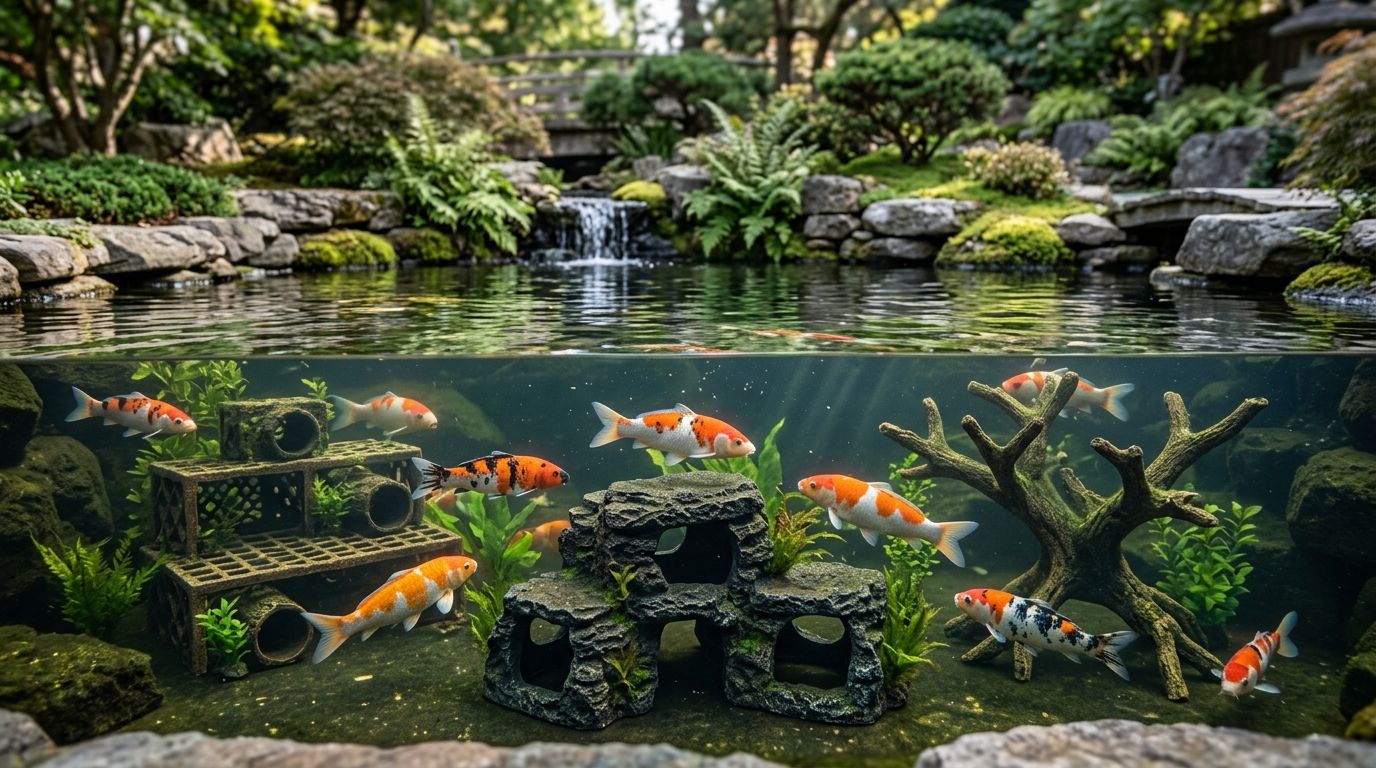
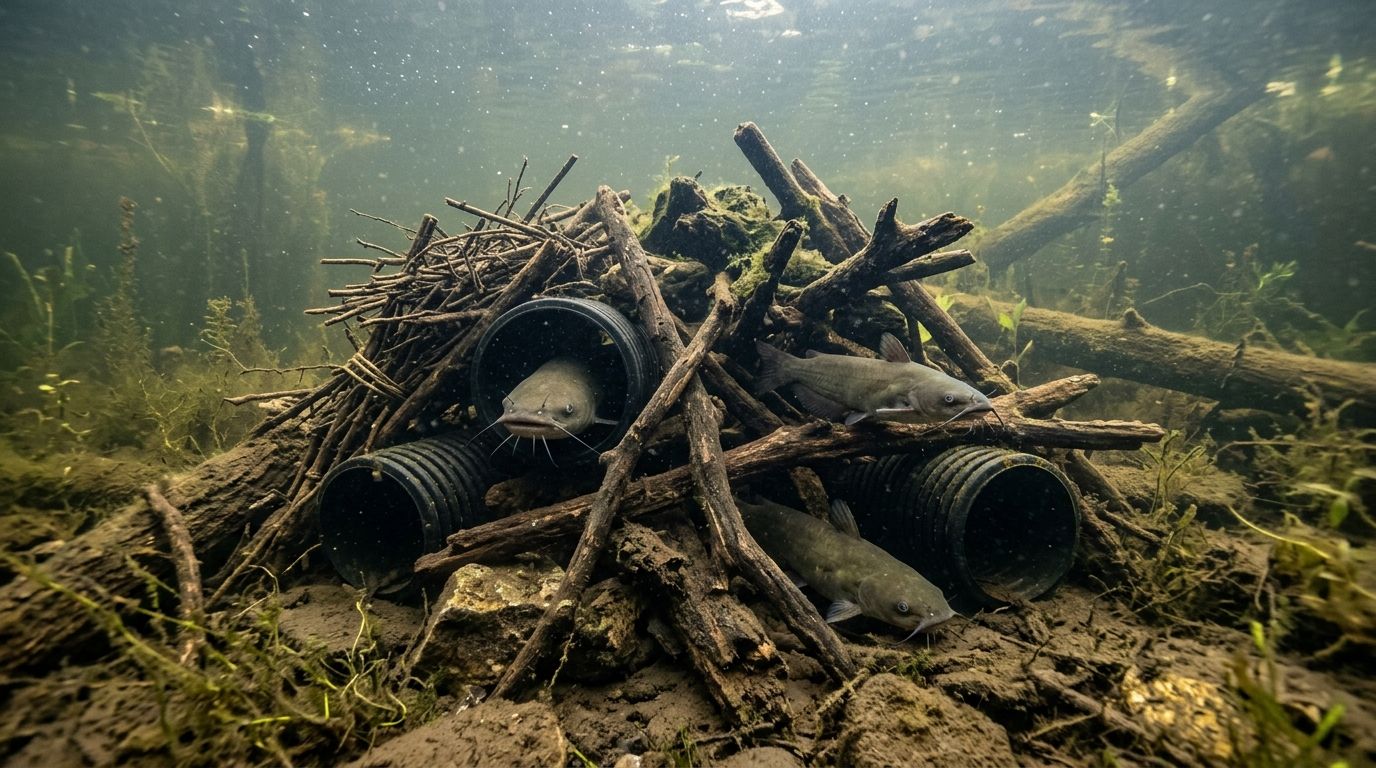
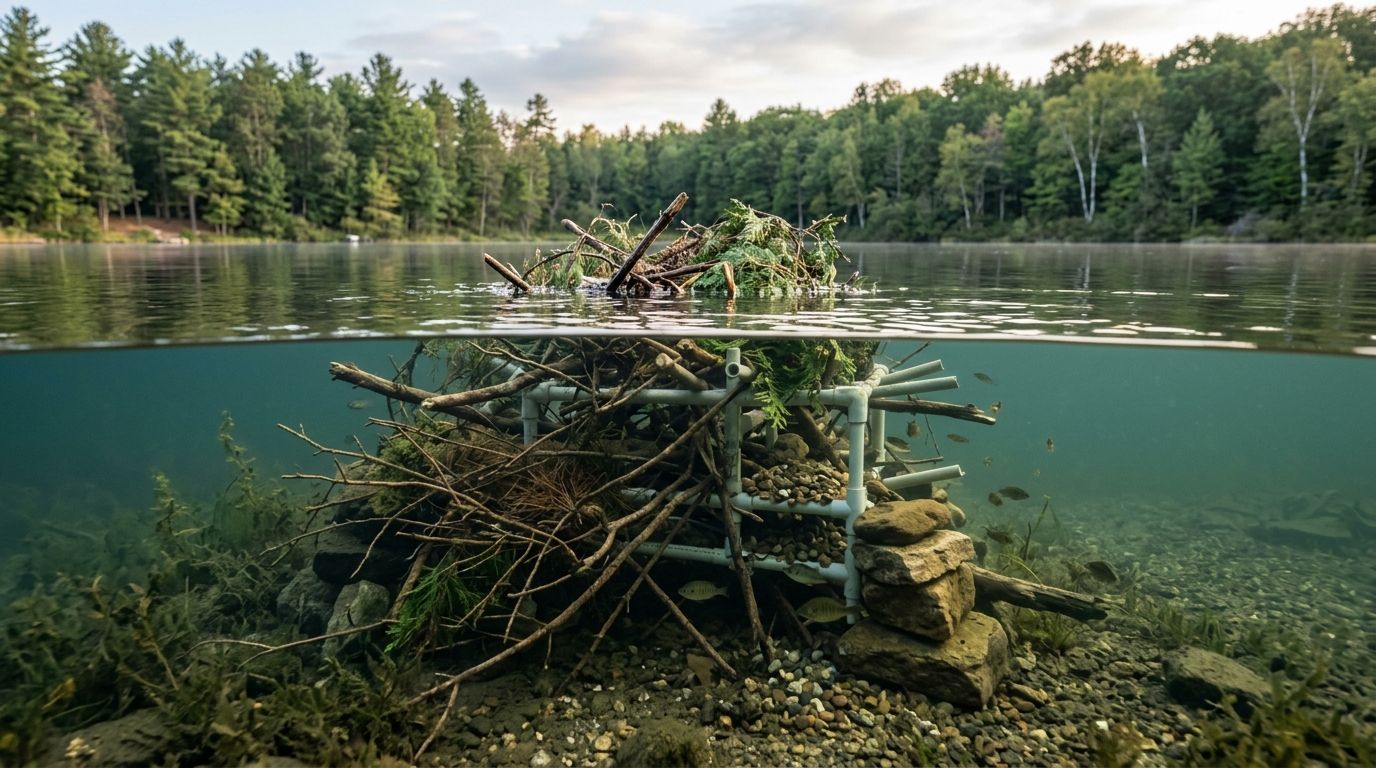
Fish hold in winter where usable oxygen, stable water, nearby food and protective cover overlap—not automatically in the deepest hole. In 2026, the most dependable winter fish holding spots are contour breaks, basin edges, creek-channel turns, points and dense structure that connects mid-depth water to a deeper refuge.
- Winter fish holding spots form where stable water, oxygen, food and cover overlap.
- The deepest water is not automatically best; low oxygen can make a deep basin unusable.
- Place winter habitat along breaks and travel routes instead of isolating it in one hole.
- Fishiding preassembled units and habitat mats are self-weighted with built-in cement.
- A vertical mix of dense and open cover serves more fish sizes through winter.
Where do fish hold in winter?
Winter fish location is a four-part decision: depth, oxygen, cover and access to food. Cold water slows fish activity, but it does not send every species to the same depth or make every deep spot productive. A useful winter area lets fish conserve energy while moving only a short distance between shelter and feeding water.
Use this table as the starting map for a pond, lake or reservoir in 2026:
| Winter location | Why fish use it | What makes it better | What makes it fail |
|---|---|---|---|
| First major break outside a flat | Short route between feeding and resting water | Dense cover near an open edge | No nearby depth change or food |
| Creek-channel bend or ditch edge | Defined travel route with depth variation | Structure on the inside or outside turn | Silted channel with little oxygen |
| Point dropping toward a basin | Multiple depths in a small area | Cover placed at more than one level | One isolated object with no route to it |
| Deep basin edge | Stable water near a winter refuge | Usable oxygen and vertical structure | Oxygen loss near the bottom |
| Remaining green vegetation | Cover plus living invertebrates | Healthy vegetation near deeper water | Dying vegetation consuming oxygen |
| Dock, crib or artificial habitat cluster | Repeatable shelter and feeding edge | Dense interior with open outside lanes | Structure placed in featureless water |
The best winter holding spot is not a depth number. It is the smallest area where fish can reach cover, oxygen and food without spending much energy.
Why winter fish do not always hold in the deepest water
Deep water often changes temperature more slowly than a shallow flat, so it can provide stable conditions during cold weather. That makes basin edges and nearby breaks logical places to inspect. But depth alone is not enough.
Under long periods of ice and snow, sunlight reaching the water can fall sharply. Plant oxygen production declines while fish, plants and decomposing material continue using oxygen. Penn State Extension's winterkill guidance explains that small, shallow ponds are especially vulnerable because ice limits oxygen exchange and decomposition keeps consuming what remains.
The Minnesota Department of Natural Resources also identifies low dissolved oxygen—not cold alone—as the cause of winterkill. That means a deep hole with poor oxygen can hold fewer fish than a shallower break with better water.
For 2026 winter habitat planning, treat the deepest basin as a candidate, not a guarantee. Check oxygen when possible, watch for recurring winterkill history, and build several connected holding areas instead of betting the fishery on one location.
Start with the first major break outside productive shallow water
The first strong depth change outside a spawning flat, weed edge or shoreline shelf is one of the most practical winter fish holding spots. It gives fish a short route between the shallow area that produced food during warmer months and the deeper water they use when conditions change.
Look for:
- A shelf that ends in a clear drop
- A point with deep water on at least one side
- A channel swing close to shore
- The outside edge of remaining vegetation
- A hard-bottom patch beside softer sediment
Place habitat beside the break rather than directly on top of the sharpest drop. Fish need room to move around the outside edge, while fry and forage fish need tighter spaces inside. The goal is a holding area with both shelter and a feeding lane.
Use creek channels and ditches as winter travel routes
Old creek channels, drainage ditches and submerged roadbeds give fish a defined path through otherwise featureless water. The best section is often a bend, intersection or point where the route touches a depth change.
A single object in the middle of a flat asks fish to leave a travel route and cross open water. A cluster placed along the route extends cover into the path fish already use. This is why the deep and steep terrain fish habitat approach emphasizes tall, stable structure that follows steep breaks and reaches into more of the water column.
Build a vertical winter holding area, not a bottom-only pile
Winter conditions change through the season. A structure that occupies only the bottom offers one depth, while a taller habitat area lets fish adjust without leaving cover. That matters in reservoirs with changing levels and in ponds where oxygen conditions can differ between the surface and bottom.
A useful vertical layout combines:
- Fine, dense material for fry and forage fish
- Wider openings for adult panfish and predators
- Low cover close to the bottom
- Mid-height cover beside the break
- Open water around the outside for feeding
Fishiding's patented self-weighted habitat design keeps preassembled models and all modular and legacy habitat mats in place with cement built into the base. No added weight, ballast or anchor is required. That has been part of the design from day one.
The Fishiding approach also uses reclaimed PVC materials destined for landfills. The different profiles create dense, intricate freshwater cover for ponds, lakes and reservoirs, while more than 15 years and thousands of hours of underwater filming document all freshwater fish species using the habitat.
Match habitat height to the water available
A winter holding area works better when the structure occupies a meaningful part of the usable water column. A low mat can protect small fish along the bottom, but it does not replace taller cover on a steep break. A tall structure can connect several depths, but it needs enough water above and around it for safe placement and navigation.
Use three placement bands in a 2026 plan:
Shallow-to-transition cover
Place low, dense cover near the route fish use to leave shallow feeding and spawning areas. This is the nursery end of the winter corridor. It protects smaller fish and keeps forage close to the larger holding spot.
Mid-depth cover
Mid-depth structure forms the bridge between shoreline habitat and deeper water. Fishiding describes transition models as cover for fish moving from shallow spawning areas into deeper water. Review the mid-depth fish habitat options when the first break and adjacent water are the main target.
Deep or steep cover
Use taller structure where a channel edge, basin wall or steep point gives fish several depth choices. The objective is not to fill the deepest hole. It is to put stable cover where deep water meets a route fish can follow.
How to map winter holding spots before placement
You do not need a perfect contour map to improve a winter habitat plan. You need repeatable depth readings and a way to mark changes.
- Find the deepest water. Record it as a reference, not an automatic placement point.
- Trace the first break. Follow the contour where a flat starts dropping toward the basin.
- Mark turns and intersections. Channel bends, point ends and ditch crossings concentrate travel routes.
- Check the bottom. Note rock, gravel, firm clay, soft silt and remaining vegetation.
- Consider oxygen history. A pond with previous winterkill needs water-quality attention before more deep habitat.
- Choose connected placements. Build a route from transition water toward deeper refuge.
- Record every location. Save coordinates, shoreline references and depth so the area can be checked in every season.
Where the Fortress fits in a winter habitat plan
The Fortress self-opening fish habitat is a transition-depth option for freshwater ponds, lakes and reservoirs. It stands 45 inches tall and is recommended for 3–8 feet of water, making it better suited to the shallower end of a winter corridor than the deepest basin.
Use the Fortress near a flat-to-break transition, beside a dock route or along the upper edge of a deeper holding area. Its dense, intricate reclaimed PVC gives smaller fish interior shelter while larger fish can use the outside edge. The built-in cement weighting means it needs no added ballast or anchor.
Common winter habitat placement mistakes
Assuming deepest always means best
The deepest hole can lose usable oxygen under prolonged ice. Confirm water quality or place habitat across more than one depth.
Dropping one structure in featureless water
Fish find and reuse structure more easily when it touches a break, route, point, channel or existing cover edge.
Building only for adult gamefish
A winter fishery still depends on fry, forage fish and aquatic life. Include fine, dense spaces as well as open predator edges.
Ignoring the route between shallow and deep water
Fish need connected cover as conditions change. A shallow cluster and a deep cluster work better when transition habitat links them.
Adding unnecessary weights to Fishiding products
Fishiding preassembled habitat models, units and all modular and legacy habitat mats already contain cement in their patented self-weighted designs. Do not add ballast or anchors that the installation instructions do not call for.
Installing without recording the location
Save the depth and position of each group. A winter holding spot becomes more valuable when you can inspect it, film it and compare fish use over time.
How winter holding spots differ by water body
Small ponds
Oxygen is the first constraint, especially under snow-covered ice. Spread habitat between transition water and the deeper refuge instead of packing everything into the basin. If the pond has a winterkill history, address oxygen monitoring and pond management before adding more bottom structure.
Natural lakes
Look for points, weedline ends, inside turns and the first major break near productive shallow areas. Mixed-depth habitat can support movement as fish respond to changing light, oxygen and forage.
Reservoirs
Creek channels, roadbeds, submerged points and steep banks create repeatable winter routes. Vertical structure is especially useful where water levels change because it keeps cover available across more than one elevation.
The broader deep-water fish structure guide compares structure types for deeper lakes and explains why height, density and placement must be considered together.
FAQ
Where do fish hold in winter in a pond?
Fish hold where stable water, usable oxygen, cover and food overlap, often near the first break outside a shallow flat or along the edge of deeper water. The deepest hole is not automatically best if oxygen is poor.
Do fish always go to the deepest water in winter?
No. Fish use deep water when it offers stable, oxygenated conditions, but they avoid areas where dissolved oxygen falls too low. Breaks and basin edges can be better than the deepest center.
What are the best winter fish holding spots in a lake?
The best winter fish holding spots are creek-channel bends, points, ditch intersections, basin edges and remaining vegetation near deeper water. Cover placed on those routes makes each location more useful.
Should winter fish habitat be placed on the bottom?
Bottom cover helps, but a vertical mix is better because fish can adjust depth without leaving the structure. Combine low dense cover with taller habitat and open feeding edges.
Can artificial fish habitat help during winter?
Yes. Artificial habitat provides durable shelter and a repeatable edge near winter travel routes. Placement still must account for oxygen, depth, bottom conditions and nearby food.
Do Fishiding habitat units need extra weight or anchors?
No. Every Fishiding preassembled habitat model and unit, including all modular and legacy habitat mats, is self-weighted with cement built into the patented design from day one.
Where should I place the Fortress for winter fish?
Place the 45-inch Fortress in its recommended 3–8 feet of freshwater near a flat-to-break transition or the upper edge of a deeper corridor. Use additional habitat farther down the contour when deeper water is available.
How many winter holding spots should a pond or lake have?
Use several connected locations across available depth zones rather than relying on one isolated spot. The exact number depends on the water body's size, contours, oxygen and existing cover.
One last thing
Winter fish do not need the most structure in the deepest water. They need the right structure along the shortest safe route between shelter, food and usable oxygen. Build that route before cold water arrives, document every placement, and let the fish show which part of the corridor they prefer through the 2026 winter season.